Spelt Coffee and Walnut Cake with Coffee Cream Cheese Frosting
This coffee and walnut spelt cake has a soft, coffee-infused sponge peppered with chopped walnuts, and an irresistible coffee cream cheese frosting. The cake can be made with either all-purpose or spelt flour.
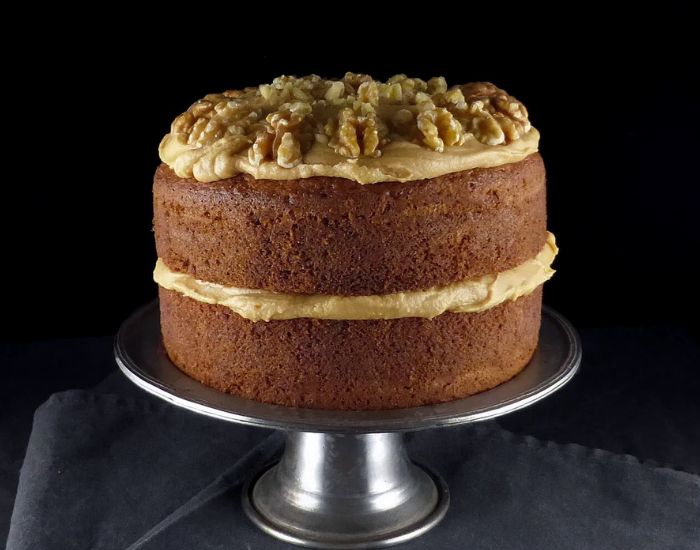

Coffee and walnut layer cake
I love cake. I mean really love cake. But coffee cake has to be my all-time favourite.
This layer cake is chunky, soft and delicious, with a coffee-enhanced sponge peppered with chopped walnuts. It is topped (and filled) with a sweet and rich cream cheese frosting flavored with more coffee. To finish off, walnuts are prettily assembled on top of the cake.
It’s a massive cake, and will easily yield 12 slices. If you fancy the idea of coffee flavoring a cake, but want a simpler cake, try my Airfryer coffee cake.
Is there actually coffee in the recipe?
Yes. Lots and lots.
My UK readers may think this is an odd question, but it appears that not every coffee cake contains coffee. In North America, the umbrella term of coffee cake includes cake that tastes great with coffee. I have to say this confused me because is there a cake that isn’t good served with coffee?
Although I have seen beauties in all shapes and sizes referred to as coffee cake, it seems that a square, sheet pan kind of cake is most common, often including cinnamon and streusel toppings.
In the UK, when we say coffee cake, we mean coffee cake, and there is most definitely some kind of coffee in the actual cake. However, it is also very likely that we will be having a cup of coffee to accompany it. Confusing, right
The origins of coffee in baking
Coffee as a flavouring began appearing in European desserts in the 17th and 18th centuries, soon after coffee itself arrived from the Ottoman Empire and the Middle East. Early recipes in France, Austria, and Germany used coffee in creams, icings, and sponges. This was often alongside chocolate, which was another alluring import.
These early continental influences, especially the Viennese coffee houses and their pastries, helped introduce the idea of coffee-flavoured cakes to Britain in the 18th and 19th centuries.
Coffee cake in Britain
By the Victorian era, British cooks had begun to use coffee essence in baking. Coffee essence (like the iconic Camp Coffee, launched in the 1880s) made it easy to add coffee flavour to cakes and frostings. One of the earliest forms of the modern coffee and walnut cake appeared around this time.
The version most of us think of today really took hold in the 1950s–1970s. It became a staple of tearooms, Women’s Institute bake tables, and cookbooks like Be-Ro and Good Housekeeping.
It’s very much a British classic, representing comfort, familiarity, and a slightly nostalgic elegance. It’s the sort of cake you’d expect on a Sunday tea table or in a National Trust café.
Why coffee works wonders in baking
Adding a touch of coffee to your cakes can transform their flavour. And there’s science behind it. Coffee contains compounds like caffeine and polyphenols, which interact with the natural compounds in chocolate and cocoa. These interactions enhance the roasted, nutty, and bitter notes, making chocolate taste deeper, richer, and more complex.
Coffee also brings a slight acidity, which helps to balance the sweetness in cakes. This prevents the dessert from feeling overly sugary or heavy, and makes the flavours more layered and interesting. Even a small amount of brewed coffee or instant espresso powder can make the chocolate “bloom,” intensifying both taste and aroma.
In recipes like coffee and walnut cake, the addition of coffee is doubly effective: the subtle bitterness of the coffee pairs perfectly with the earthy, slightly tannic walnuts. The result is a cake that is sweet, nutty, and indulgent, but with a refined balance that keeps it from being cloying.
Although the flavour of coffee is part of this cake’s charm, and supposed to be noticed, in chocolate cakes, it is barely detectable. I know a lot of people are put off by coffee in cakes, but even non-coffee drinkers would be hard pushed to notice it. What they would notice is the depth of chocolatey-ness that only adding coffee can bring. I add it to every chocolate cake, brownie and muffin in my kitchen, and you should, too.
Coffee and walnuts: the perfect pairing
Coffee and walnuts have a natural harmony that explains why the combination has become such a British favourite. Coffee brings warmth, bitterness, and depth, while walnuts add an earthy richness and a slightly tannic note that mirrors and softens the sharpness of coffee. Together, they create a balance that’s both comforting and sophisticated.
This pairing likely became popular in the early 20th century, when nuts were considered a luxurious addition to home baking. Walnuts were the ideal choice as they were widely available, yet elegant enough for special occasions. Their texture also adds contrast to the softness of the sponge and the smoothness of the buttercream.
Even today, the combination feels timeless: a cake that’s sweet but not cloying, nutty but not heavy, with a flavour that lingers. Much like the last sip of good coffee after a long conversation.
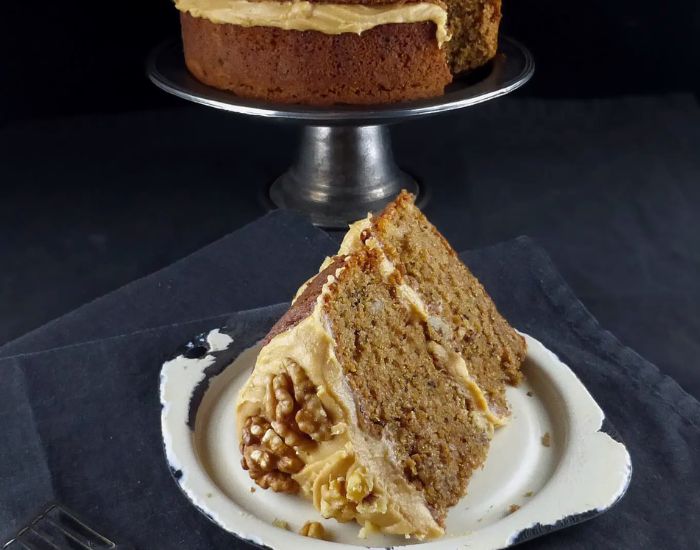
Can I substitute the spelt flour?
Yes, you can use plain (all purpose) flour interchangeably for this recipe.
I’ve made this cake so many times and it never disappoints. When I started The Spelt Kitchen, this coffee and walnut spelt cake was the first recipes I wanted to re-create using spelt flour. The plain (all-purpose) flour was swapped out for spelt flour in a straight 1:1 ratio. No other changes were needed.
The texture changed very little. Perhaps it was slightly more dense, but not so you would ever notice. I also found that the spelt flour provided a nuttier taste that went so amazingly well with walnuts. So, if you do have access to spelt flour, I highly recommend you trying it for this coffee and walnut cake.

Coffee and Walnut Spelt Cake (with Coffee Cream Cheese Buttercream Frosting)
Ingredients
Cake:
- 50g (⅓ cup) walnuts (extra for decorating)
- 225g (1 cup) butter (softened)
- 225g (1 cup + 2 tbs) sugar
- 4 eggs (large)
- 200g (1⅔ cups) spelt flour (see note 1)
- 2½ tsp baking powder
- ½ tsp bicarbonate of soda
- 1½ tbs instant coffee powder
- 3 tbs milk
Frosting:
- 80g (⅓ cup) butter
- 90g (¾ cup) cream cheese
- 250-350g (1½ - 2¼ cups) icing / powdered sugar
- 1 tsp hot water
- 1 tbs instant coffee powder
- walnuts (decoration - optional)
Instructions
Cake:
- Crush your walnuts. Do this by either placing your nuts in a bag, and bashing with a rolling pin. Or, blitz them in a food processor. Put them to one side for a short while.
- Pre-heat the oven to 175ºC (350°F).
- Grease and line 2 x 7" (18cm) cake tins (you can use two 8" pans but the layers will be thinner).
- In a food processor, or by hand, beat the sugar and butter together until light and fluffy.
- Add the eggs, one at a time.
- Combine the walnuts, flour, baking powder and baking soda.
- Fold into the wet ingredients.
- Mix the coffee and milk together then mix into the batter. A fairly soft dropping consistency should be achieved (add a little more milk if needed).
- Divide the mixture equally between the two pans and then bake for around 30-35 minutes (if baking 8" cakes, bake for 20-25 minutes).
- The cakes are ready when they bounce back after being gently pushed down (or an inserted skewer comes out almost clean).
- Remove from the oven and let them cool for about ten minutes.
- If using spring-form pans, remove the sides until the cakes are fairly cool and then turn out onto a wire rack (top side down) until they are completely cold.
Frosting:
- Beat the butter and cream cheese together until nice and smooth.
- Add the coffee to the water and stir in.
- Finally, add the icing sugar just until a thick, spreadable consistency is achieved.
- Spread half of the frosting on the flat side of one of the cakes.
- Place the other cake on top and then slather the remaining frosting all over the top of it.
- Decorate with pretty walnuts (I used some whole and some crushed).
- This is a big cake, tall cake so you only need thin slices. Enjoy!
Notes
- You can use spelt or regular flour for this recipe (just use the same amount).