Strawberry Swirl Spelt Pound Cake
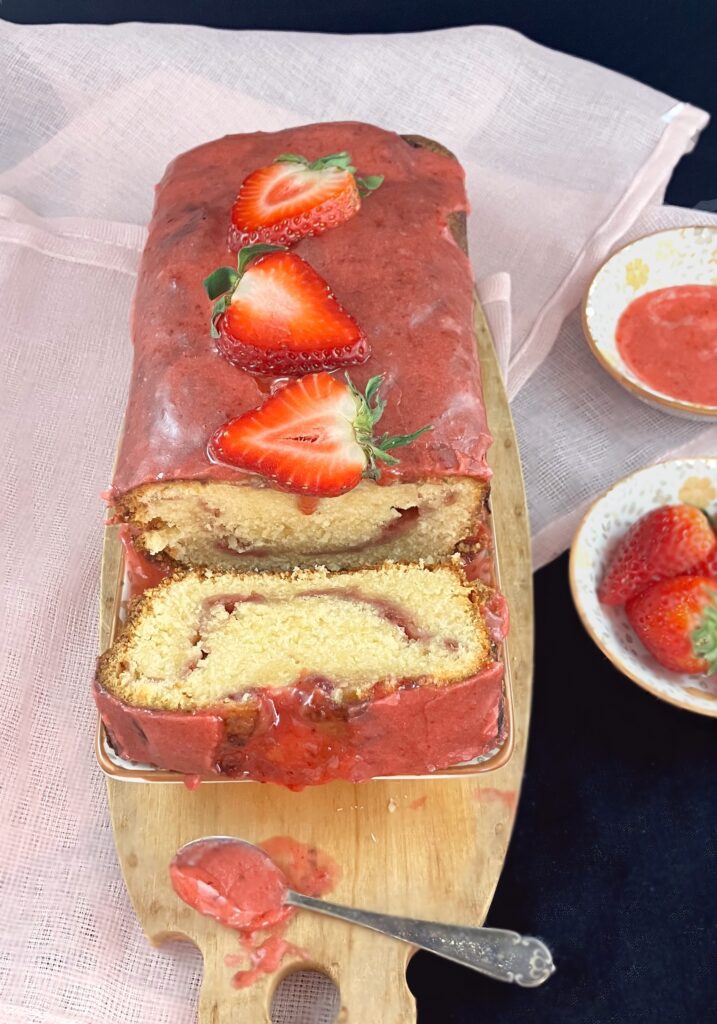
This scrumptious strawberry swirl spelt pound cake is topped with a sweet, fresh strawberry glaze and is every bit as good as it looks. Dense yet soft, buttery yet light, the rich sponge is rippled with a homemade strawberry swirl that delivers little bursts of berry in every slice.
This recipe features in my 33 spectacular spelt flour cake recipes. Which one is your favourite?
|
|
| My strawberry swirl pound cake |
| The origins of pound cake |
| Pound cake’s evolution |
| Berries in cakes |
| Homemade strawberry sauce |
| Simple strawberry glaze |
| More berry spelt cake recipes |

My strawberry swirl pound cake
I’ve experimented with just about every kind of cake you can make with spelt flour. Not surprising, really, given that this blog is called The Spelt Kitchen. But this was my first ever pound cake, and I can confidently say it won’t be my last.
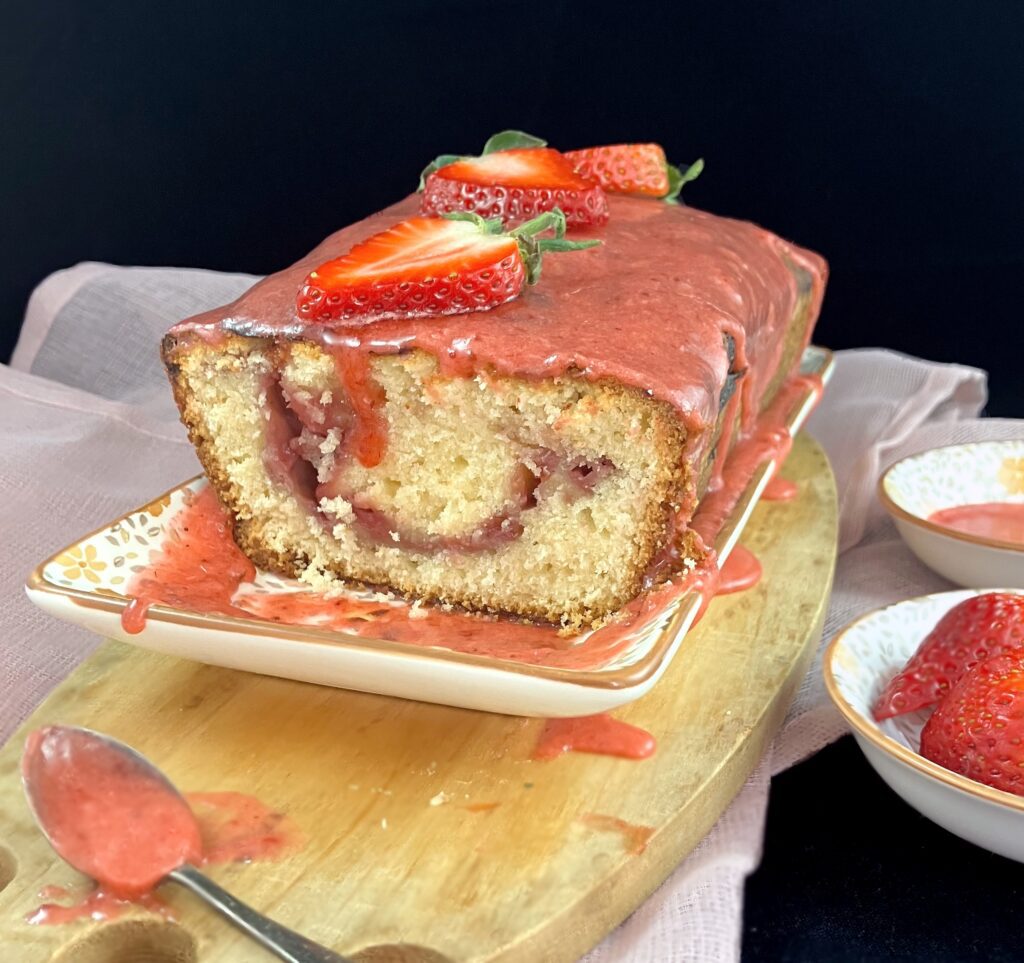
The sponge is dense in the best possible way, yet melts in the mouth. The crust has just the right amount of crispness, while the homemade strawberry sauce swirls elegantly through the cake. Finished with a fresh strawberry glaze, it’s the kind of cake that is perfect for all occasions. Even the, I want cake just because moments.
The origins of pound cake
Despite what I always assumed for many years, pound cake did not originate in the United States. Its roots lie firmly in Europe, with the earliest written references appearing in the early 18th century. One of the first known recipes was published in 1747 in The Art of Cookery Made Plain and Easy by English writer Hannah Glasse. As the name suggests, the original cake was made using a pound each of flour, butter, sugar, and eggs. A simple, memorable formula at a time when scales were uncommon and ratios mattered. For those unfamiliar with the term pound is a unit of weight equal to roughly 450 grams (16 ounces).
Early pound cakes were dense, rich, and sturdy, designed to keep well rather than be light or airy. With no chemical leavening available, structure came entirely from eggs and careful mixing. The crumb was tight, the crust firm, and the flavour deeply buttery.
Traditionally, pound cake was baked in loaf tins or ring-shaped pans and served plain, or with simple additions such as citrus zest, dried fruit, or a light glaze.
Pound cake’s evolution
Pound cake made its way to the United States during the 18th century, brought over by European settlers, and quickly took hold in American kitchens. By the 19th century, it had become a baking staple, and over time, pound cake became almost synonymous with American home baking.
As ingredients became easier to source and baking powder more widely available, the original formula began to evolve. American bakers adapted the cake to suit local tastes and conveniences, creating versions that were still rich and buttery but slightly lighter in texture. New flavourings such as vanilla, almond, citrus, and later cream cheese or sour cream were introduced, along with fruit swirls, glazes, and marbled batters.
Pan choices evolved too. While early pound cakes were baked in simple tins, later versions were often made in decorative Bundt pans, which became especially popular in the mid-20th century and suited the cake’s dense, structured crumb perfectly.
Despite countless variations, pound cake remains defined by its buttery flavour, close crumb, and reliability. It holds its shape beautifully, slices cleanly, and provides a sturdy canvas for glazes, sauces, and fruit — all reasons why this classic cake has endured for centuries.
Berries in cakes
When it comes to adding berries to my cakes, I usually reach for the bold, strong-flavored ones like blueberries. Blackberries and raspberries. A fruit that really stands up to the sweetness of the batter. Softer, milder berries, such as strawberries, often get a little lost in baking, so I usually avoid them in my baking.
That said, I love fresh strawberries. I think they are perhaps my favourite fruit. I grabbed some from Lidl the other day. They were cheap, and I always get excited when they first appear in the supermarkets after winter. Sadly, they sat in the fridge for a while, completely unloved and untouched. I racked my brains for a way to use them up. Originally, I had planned to make sweet strawberry buns, but in the end, a cake felt like the perfect choice. I’m so glad I did.
You could easily adapt this recipe to suit any berries you have. I think cherries would be awesome. Or, go for apricots or plums, instead.
Homemade strawberry swirl sauce
The strawberry sauce is the heart of this cake’s beautiful, fruity pattern, and it’s ridiculously easy to make. I have adapted it from my homemade strawberry sauce, which uses chia seeds to thicken it. This time, the sauce is more cake friendly and has a touch of cornflour.
Start by chopping 200g (7 oz) of strawberries into small pieces and add them to a pan with 1 teaspoon of water and 1 teaspoon of cornstarch. Cook gently for about 10 minutes, until the strawberries are soft and mushy. Let the mixture cool slightly, then blitz it in a food blender until smooth and silky. It’s best to prepare the sauce in advance so it has time to cool and thicken; I often make mine the night before, but even a few hours works perfectly.
When your cake batter is ready, remove the sauce from the fridge and set aside 2 tablespoons for later (it goes in the glaze). Pour half of the batter into the prepared pan and smooth out with a knife until fairly even. Top it with ¾ of the sauce. Using a knife, gently swirl the sauce into the batter to create those swirls. Be careful not to over-mix, as they will disappear.
Dollop the last of the batter on top, and again, smooth with a knife until even. Top with the last ¼ of the strawberry sauce and swirl that in, too. Then it’s ready to bake.
If you don’t want to make the sauce from scratch, use around 100–120g (3½–4 oz) of high-quality strawberry jam or preserve. Warm it slightly and, if needed, stir in a tiny splash of water to loosen it so it can be swirled through the batter.
Simple strawberry glaze
To finish off this cake, the strawberry glaze adds a sweet, glossy touch that looks as good as it tastes. Simply mix the retained strawberry swirl sauce with enough icing (powdered) sugar to create the thickness you desire. Use more icing sugar for a thicker frosting, or less to make it easier to drizzle.
Once you’ve reached the right consistency, pour it generously over the cooled cake. The glaze not only adds sweetness but also highlights the beautiful strawberry swirls inside. Top with a few fresh strawberries for a little extra drama and colour.

Cardamom & raspberry cake (no sugar)
Soft gingerbread with lingonberries
Blueberry white chocolate mud cake
Raspberry & blackberry cupcakes
Lime & blackberry Swedish mud cake
Blueberry & lime cake (lighter)
Strawberry Swirl Spelt Pound Cake (with a Strawberry Glaze)
Ingredients
Strawberry swirl sauce:
- 200g (7 oz) strawberries
- 1 tsp water
- 1 tsp cornstarch
Cake:
- 240g (2 cups) spelt flour (see note 1)
- 1 tsp baking powder
- ¼ tsp baking soda
- ½ cup milk
- 1 tbsp fresh lemon juice
- 110g (½ cup) butter (room temperature)
- 250g (1½ cups) white sugar
- 2 eggs (medium - room temperature)
Strawberry glaze:
- icing sugar (as much as is needed)
- strawberry swirl sauce
- strawberries (for decoration)
Instructions
Strawberry swirl sauce:
- It's a good idea to prepare the strawberry swirl sauce in advance. I made mine the night before, but it doesn't need to be that far ahead; you just need time for the sauce to completely cool and thicken.
- Chop the strawberries into small pieces and add to a pan along with a teaspoon of water and the cornstarch.
- Cook for about 10 minutes until the strawberries are mushy.
- Allow them to cool a while, and then blitz them in a food blender until nice and smooth.
- Cover and keep in the fridge until you need it.
Cake:
- Preheat the oven to 175℃ (350°F).
- Grease a loaf tin (mine is 23cm x 12cm / 9" x 4¾") and line it with baking paper (I just use a strip as wide as the pan so that it is easy to lift the cake out).
- In a medium bowl, combine the flour, baking powder and baking soda. Set aside.
- In another bowl, whisk together the milk and lemon juice. Set aside.
- Using an electric mixer or food processor, cream the butter and sugar until light and fluffy (around 3-4 minutes). Scrape down the sides of the bowl.
- Beat the eggs in, one at a time. Scrape down the sides of the bowl again.
- On a low speed, mix in around a quarter of the flour mixture. Follow this by adding one third of the milk mixture. Repeat these two steps, finishing with the flour. Finally, scrape down the sides of the bowl, and give it one last stir.
- Pour half the batter into the pan. Take the strawberry swirl sauce from the fridge and retain 2 tbsp of the glaze.
- Spoon ¾ of the remaining sauce over the batter and gently swirl with a knife. Add the rest of the batter, smooth, and top with remaining sauce, swirling gently. Read here for a little more information.
- Bake for around 45-50 mins. If you notice that the cake is browning too much on top, cover with some foil. The cake is ready when an inserted skewer comes out clean.
- Allow the cake to cool in the pan for around 10 minutes, and then turn out on to a wire rack.
Strawberry glaze:
- Mix the remaining strawberry sauce with as much icing sugar needed to make a thick glaze. When you've reached the correct consistency, pour the glaze over the cake. Top with a couple of strawberries, slice and enjoy!
Notes
- You can use spelt or regular flour for this recipe (just use the same amount).