
Which Bread Machine Cycle is Best for Wholegrain Spelt?
Have you ever wondered which bread machine cycle is best for wholegrain spelt? Does it make any difference whether you use the specifically designed wholemeal setting, or can you make great spelt loaves using the rapid option? In this post, I troubleshoot problems to find the best possible cycle for wholegrain spelt.
Oh, and if you’re new to spelt flour and still finding your feet, check out my tutorial: A Beginner’s Guide to Spelt Flour.
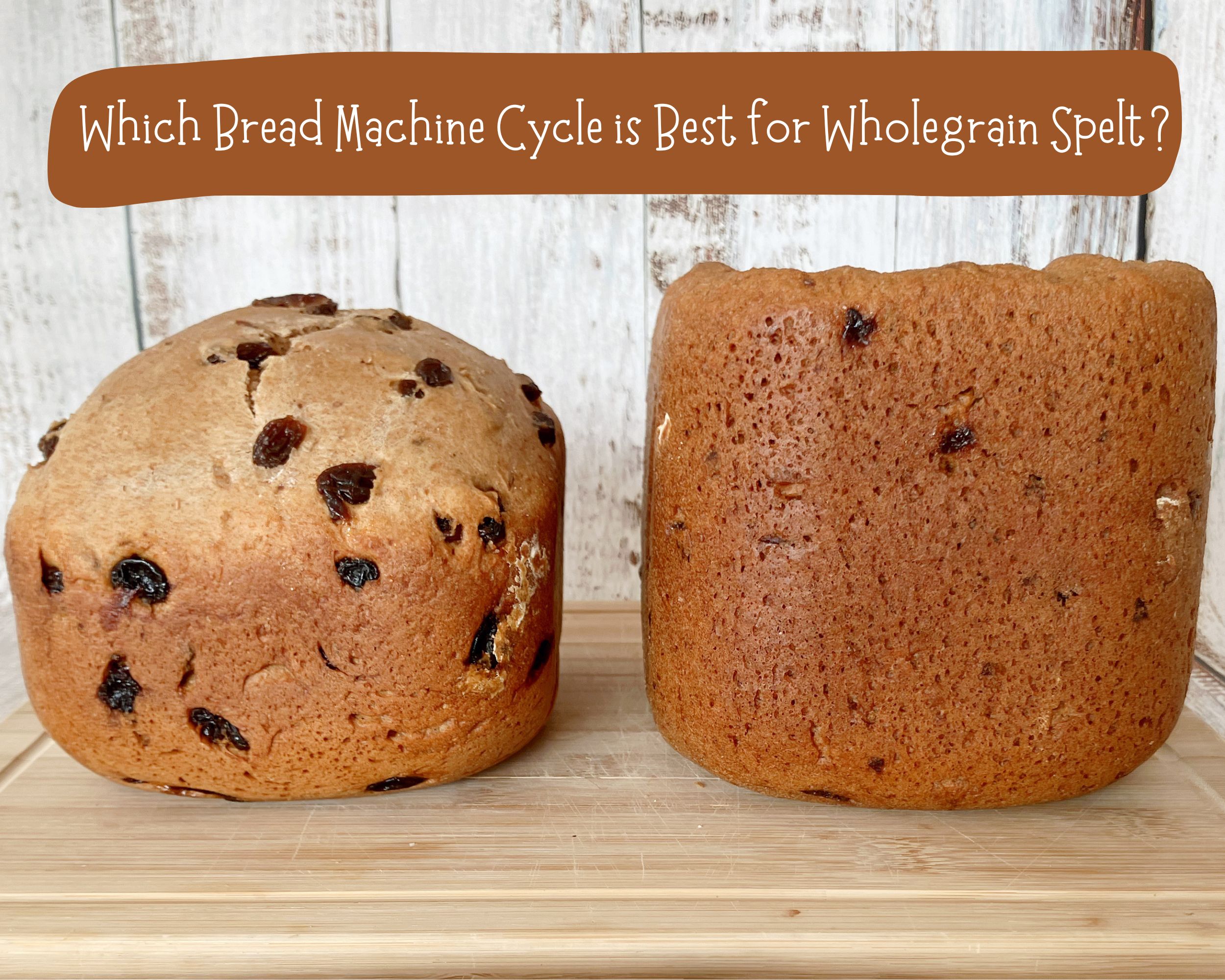

When using my bread machine to make loaves, I always noticed that the tops were a little sunken. I honestly didn’t pay too much attention to it, as they tasted great, and I thought the issue was perhaps just wholemeal spelt flour.
Then I got to thinking about why, and decided to see if playing around with my bread machine’s cycles might produce a different outcome. So, I tested the same recipe several times, using both the wholemeal flour setting and the rapid cycle, to see what would happen.
What’s the difference between wholemeal, wholewheat and wholegrain?
Before we start, there is a little difference in terminology across countries. In the UK, we tend to refer to all products that use full grain as wholemeal. Whereas, in the US for example, they might refer to full grain flour as wholegrain or wholewheat.
However, these names are not always entirely accurate. I use wholegrain spelt, but because I am British, tend to call it wholemeal. Therefore, you might see both terms used interchangeably in this post. So confusing. If you are as befuddled as me, the people over at Cotswold flour have written a great explanation of what these differences are.
The recipe
I have been making my recipe for wholemeal cinnamon and raisin bread for a long time. It’s on my blog, and I never use a recipe unless it is tried, tested, and I am happy with it.
I made several loaves, amending the measurements a little in some places, but for the main comparison between the wholemeal and rapid cycles, the ingredients and amounts used were exactly the same:
- 50g (3½ tbsp) butter
- 1 egg
- 250ml (1 cup) milk
- 480g (4 cups) wholemeal spelt flour
- 1 tsp salt
- 1 tbs cinnamon
- 2 tbs brown sugar
- ¼ tsp nutmeg
- 120g (4¼ oz) sultanas
- 7g (2¼ tsp) dried yeast
Can you use spelt flour in a bread machine?
I’ve always used spelt in a bread machine, particularly to prepare dough (I am not a fan of kneading by hand). Early on, I didn’t pay much attention to whether the machine had a special cycle for spelt. I didn’t even know there were machines with dedicated spelt flour settings, until but one of my readers informed me that Panasonic makes one. I’ll add that to my Christmas list, then.
So, I just went with the regular wheat settings. As my understanding of spelt grew, I started to realise that those wheat-based cycles weren’t always optimal. Spelt does contain gluten, but it behaves very differently in dough from modern wheat flour.
For this reason, most manufacturers offer only general guidance for spelt, often suggesting blending it with bread flour or using the machine solely for mixing and kneading before baking in the oven. These approaches work well in some cases, but I wanted a loaf made only from spelt flour. I started to realise that using a bread machine often comes down to managing cycle length rather than changing the ingredients themselves.
What happens to spelt bread on a wholemeal bread cycle?
As my machine does not have a special cycle for spelt flour, I used the normal wholegrain setting for my cinnamon loaf. And on my bread machine it is a long cycle. In total, it takes three hours and 40 minutes to complete. The reason for a longer wholegrain cycle is that the flour ferments more slowly than white flour due to the presence of bran, and therefore needs more time to develop and rise.
Previous to this experiment, I had made my wholegrain cinnamon loaf many times. I remember always being so excited at how well the dough rose. Way higher than I might have expected for wholemeal dough of any kind. What baker doesn’t love to see a good rise? In fact, at times, I worried that the dough would overflow the pan once it started baking. However, every time, disappointment would soon follow. After the machine started baking, I would eagerly peer in, and what I saw always brought the kind of dismay that nobody wants to feel. Not only did the bread stopped rising, it sunk.
Apart from the sunken top, the bread was delicious. I re-created the same recipe for my cinnamon raisin wholemeal spelt loaf several times until I felt it was good enough for the blog. I accepted that a sunken top was the way it was always going to be; that it was just a quirk of baking in a machine. The bread was delicious, and that was all that really concerned me then.
Why might spelt dough sink in a bread machine?
After writing my post spelt vs plain flour: which makes the best cupcakes, I quite liked the analytical side of how and why spelt flour behaves the way it does. So, I thought more about why my wholemeal spelt loaves sunk at the baking stage of a bread machine cycle.
I made several loaves for the purpose of this experiment using the wholemeal bread setting, tweaking certain ingredients. The same thing happened each time: that beautiful rise followed by the rapid sinking. But what could the problem be?
Some consideration and reflection made me think that using too little flour was likely the culprit. I make my spelt dough wetter and stickier at the beginning of the mixing and kneading process. This is because spelt incorporates liquid more slowly than modern wheat flour. The longer the dough is worked, the more it firms up. I’ve seen spelt dough go from sticky to too dry in seconds.
As I’ve mentioned, I’m not a fan of kneading by hand, so using the bread machine to do the kneading worked perfectly for me. Once the dough was ready, I would add as much flour as needed before shaping it and baking it in a regular oven. But was a wetter dough causing issues when left in the machine to also bake? Research backed up my suspicions: too much liquid (or not enough flour) can cause a loaf to sink after the proofing stage. Bingo. I had discovered why my bread was sinking.
Or so I thought. Wrong. After adding more flour, I was still left with a deflated top.
Using the wrong yeast?
If it wasn’t too little flour, could it be the yeast?
Many people in Sweden bake with fresh yeast. In the past, I’ve experimented with it myself (it smells divine), but prefer the convenience of dried. We have two types of dried yeast, one for sweet dough and one for savoury. That’s it. We don’t (at least to my knowledge) have a special kind of yeast for bread machines. I wondered if my yeast was causing the issue of a fast rise and rapid drop.
The USA seems to have so many more options when it comes to yeast, including active dry yeast, instant yeast, and SAF yeast, to name just a few. The choice is mind boggling, so I am glad that they do things a little more straightforward here in Sweden. King Arthur offer a really useful resource on yeast, and state that you can use active dry and instant yeast interchangeably. Apart from when baking bread in a machine. Then, they recommend that active dry yeast is the best, but if using instant yeast, to use less. I did just that.
But no, it didn’t seem as though the yeast was the issue, either.
Is a long proofing the problem?
One thing I did know was that white spelt flour often produces a very fast rise in leaner breads (wholegrain is usually a little slower). In the warm, contained environment of a bread machine, the yeast activates quickly. Spelt has a delicate gluten structure, which doesn’t tolerate extended fermentation (proofing) particularly well and can collapse if it has over-expanded.
So, could a cycle that was too long be the cause of a deflated loaf? Maybe the issue wasn’t the yeast or the hydration at all, but the length of the cycle itself, especially when using a long wholemeal setting. To test this, I made the same loaf twice, once with the longer cycle, then again using a rapid cycle.
In hindsight, the result should have perhaps not have been that surprising.
Using a rapid bread machine cycle with wholemeal spelt
The cycle on my bread machine is really quick. At one hour and 30 minutes, it is only five minutes longer than the dough setting. This is more than two hours shorter than the regular wholegrain cycle.
Before this experiment, I had never used the rapid cycle on my bread machine. I guess I didn’t really know what the purpose of it was (apart from that it was quicker, obviously). When researching the cause for sunken tops, it appeared that this wasn’t just a spelt flour problem, or even wholemeal. It happened for all kinds of white flour, too, but they were due to the reasons I’ve given above (and ruled out).
The end result was very different to the long wholemeal cycle. Although the loaf was a little stumpier, it was beautifully domed. No sinkage at all. The rising part of the cycle was much shorter, which meant that the spelt dough no longer had the opportunity to over-proof.
Therefore, it appears that perhaps the regular wholemeal cycle on a bread machine is way too long for spelt flour, and this was the reason for the sinking. The poor loaves had expanded so much that spelt’s weaker gluten structured caused them to collapse under the strain of all that hard work.
Side by side analysis
Aside from the sunken top, there were other substantial differences between the two loaves. Let’s take a closer look:
Appearance:
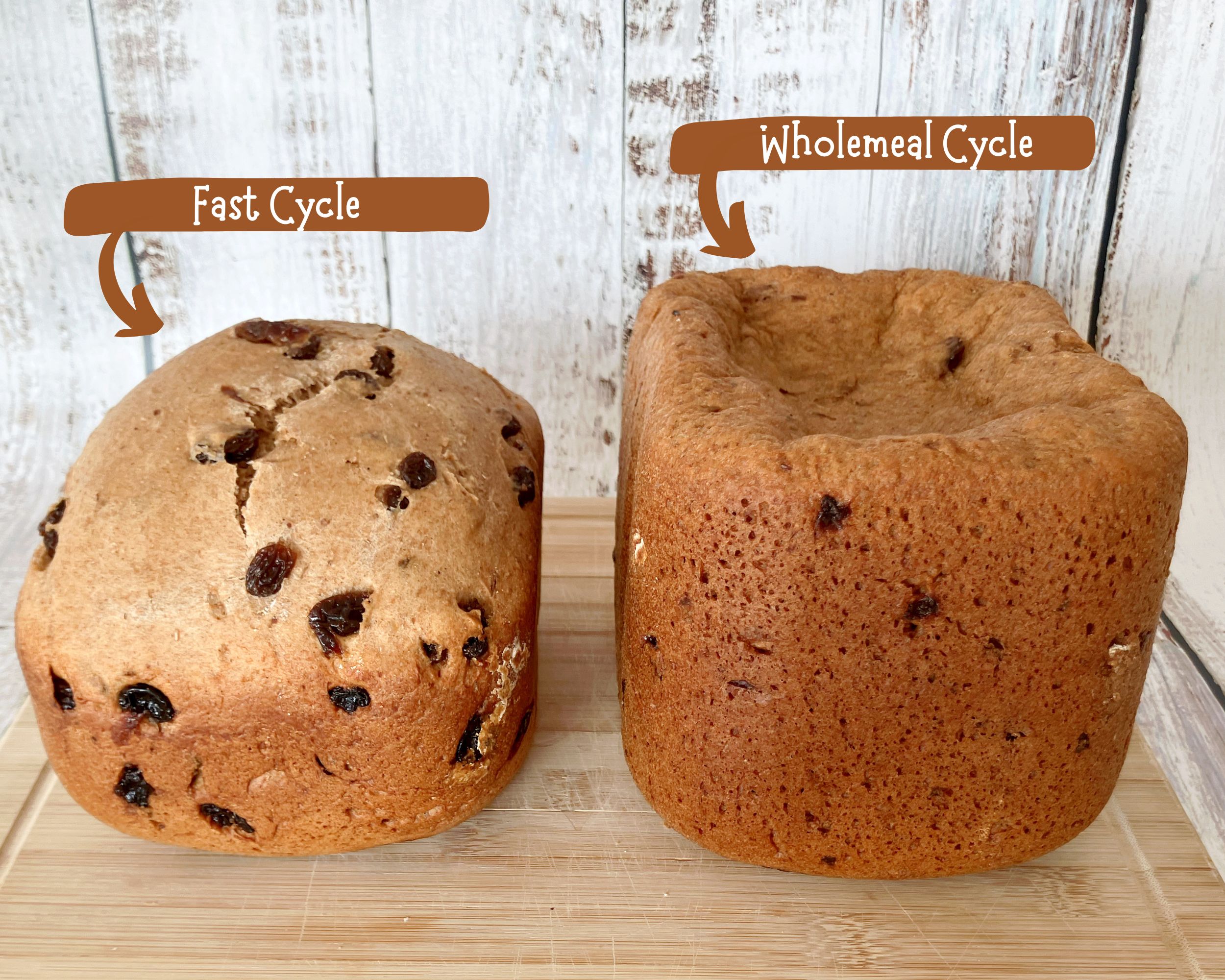
The biggest difference is how they look. The loaf baked on the longer cycle is much taller, although it has definitely sunk. In comparison, the fast cycle bread has a clear dome, with a slightly cracked top, but is much shorter. The image below shows the stark contrast between the top of the loaves:
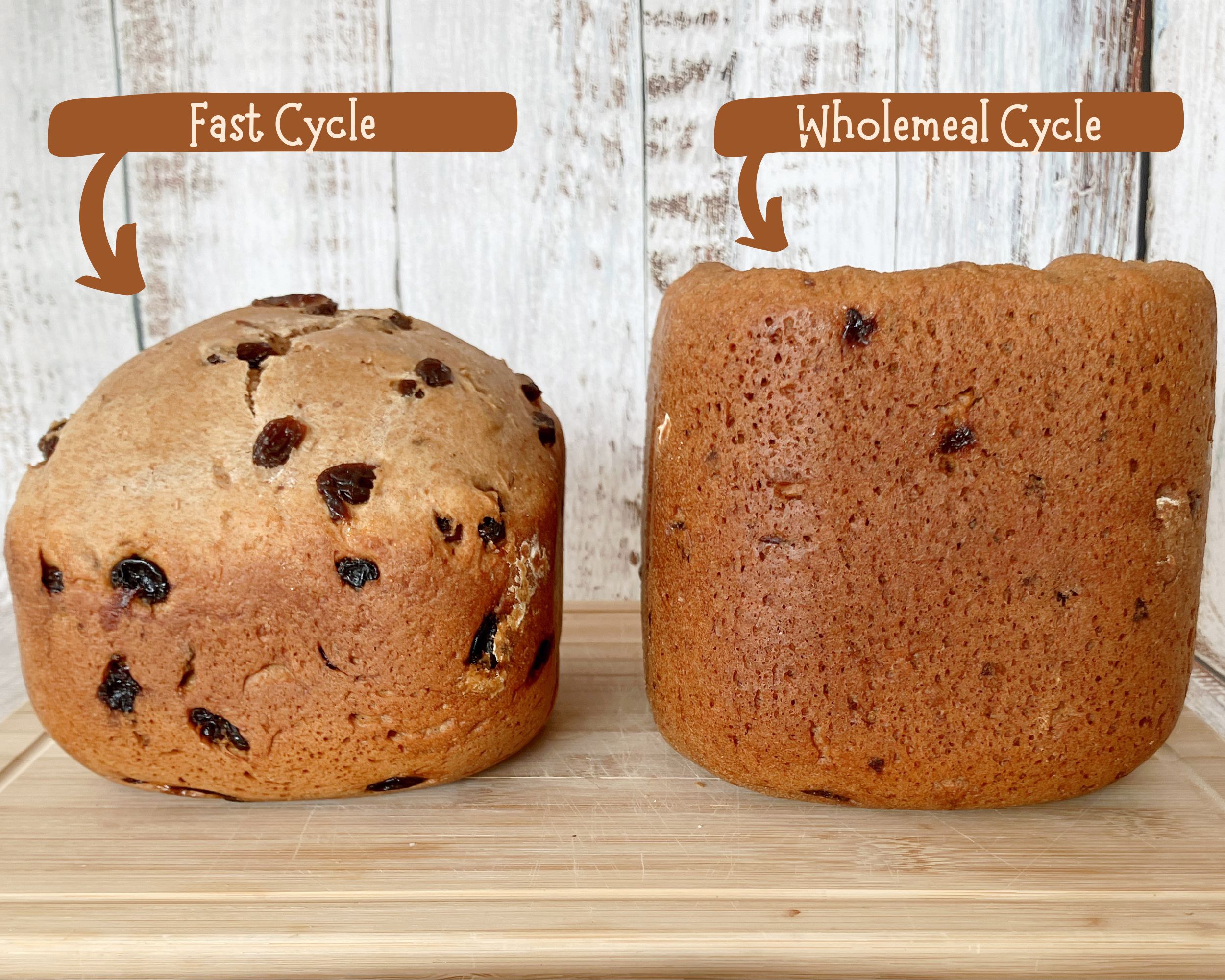
Even the coloring is different, with the fast cycle loaf a different shade at the dome. Although I used exactly the same amount of raisins, they are much more noticeable in the fast cycle loaf, due to the loaf being a little smaller in size.
Crumb and texture:
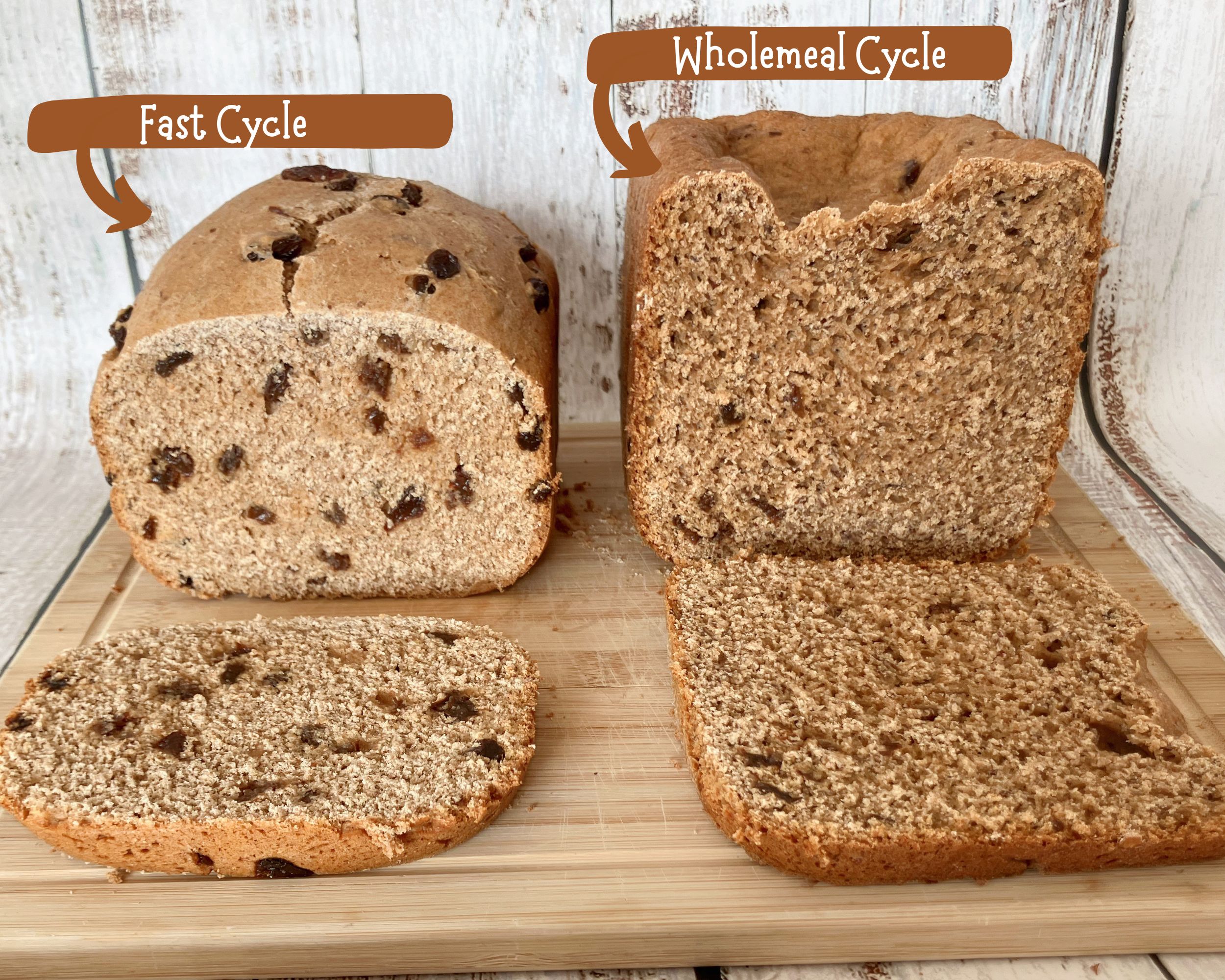
As you can clearly see from the picture below, the crumb on both breads is also substantially different. The crumb on the shorter cycle was more hard-packed and when sliced, it was sturdier and less fragile. The taller loaf had a looser, crumblier crumb, which was evident when I sliced it.
This fragility was particularly noticeable when I toasted a slice of both loaves. The taller loaf fell apart a lot easier when I tried to butter it. The short cycle bread held its shape a lot better.
Taste test:
Perhaps the most important aspect of the experiment. Looking good only gets you so far. Despite the stark contrast between how the loaves looked, there wasn’t as much difference in the taste between the two. Both loaves were dense, which is to be expected when using all wholemeal flour, but the flavor was the same.
Overall, the crumblier texture of the long cycle loaf was less pleasing than the sturdier crumb of the bread made on the quick cycle.
So, which bread machine cycle is best for wholegrain spelt?
I think my biggest takeaway from this experiment is that it is perhaps better to skip the machine and make your loaves the conventional way. By doing that, you have complete control over every step. There is no one-size fits all time for proofing and baking, and when making bread the old fashioned way, you can keep a closer eye on things. Sometimes my dough has doubled in size in 60 minutes. Other times, it is closer to 90. Same goes with the baking. You simply don’t have this level of control with a bread machine.
However, let’s not forget the purpose of this post. If using a bread maker, a rapid cycle is the clear winner for me. It is quicker to make, has a crumb that is not only more pleasing to eat, but it is also sturdier, especially when toasting. There is less bread (because the loaf doesn’t rise as much), but its compactness is what I liked most.
As for the taste? As mentioned, there wasn’t a great deal of difference in the actual taste. But there was a very interesting way for me to unconsciously determine which was the best. I made a lot of bread to carry out this experiment and needed to freeze most of it. I had separate bags for the different breads, for no other reason other than my bags could only fit in one loaf. They were placed in the freezer and whenever I fancied a slice of raisin cinnamon bread, I took a slice out. The fast cycle bread was the one I reached for every time.
Hopefully, if you found yourself here because you had also scratched your head about deflated tops, this might offer a little insight. However, it is also important to point out that these are my findings based on the machine I use. I am not an expert, and it’s highly possible that you might have different outcomes and experiences.

6 thoughts on “Which Bread Machine Cycle is Best for Wholegrain Spelt?”
Leave a Reply

Have you tried making a sourdough loaf with spelt flour in a breadmaking machine?
Hi Veronica,
I’ve never made sourdough at all. It’s on my bucket list, though! If you try it, let me know how you get on!
Thank you so much for this article! Your careful research has clarified all my spelt flour issues..(Well, almost – do you have any helpful hints oncake made with spelt ?)
Hi Shula! So wonderful to hear, thank you so much for letting me know! I find cake much easier just to do a straight swap. What kind of issues are you having?
I’ve never used spelt flour but was just reading about it. So I searched for bread machine spelt recipes and found this. Cinnamon raisin is even better. I’ve had occasional problems over the years with collapsed loafs and the typical suggestion is to reduce the amount of yeast by 1/4 teaspoon. Reducing the rise time, as you found, would have the same effect. I just bought a new bread machine on Amazon. It has 29 cycles including one where you can create your own custom cycle and save 4 of them. You can also adjust cycle times on the fly. It was only around $100 and the instruction & recipe booklets were excellent. I’ve only made one loaf and it came out great. Well, almost. I thought it needed to rise more so I extended the rise time on the fly. Ha! Yep, the loaf collapsed some. So I’m going to get some spelt flour, study the cycles to see if there is one that might work for spelt and start experimenting.
Thanks for your comment, Mike. Please come back and let me know how your experiments go! I am always researching and experimenting and it’s a continuous learning curve!